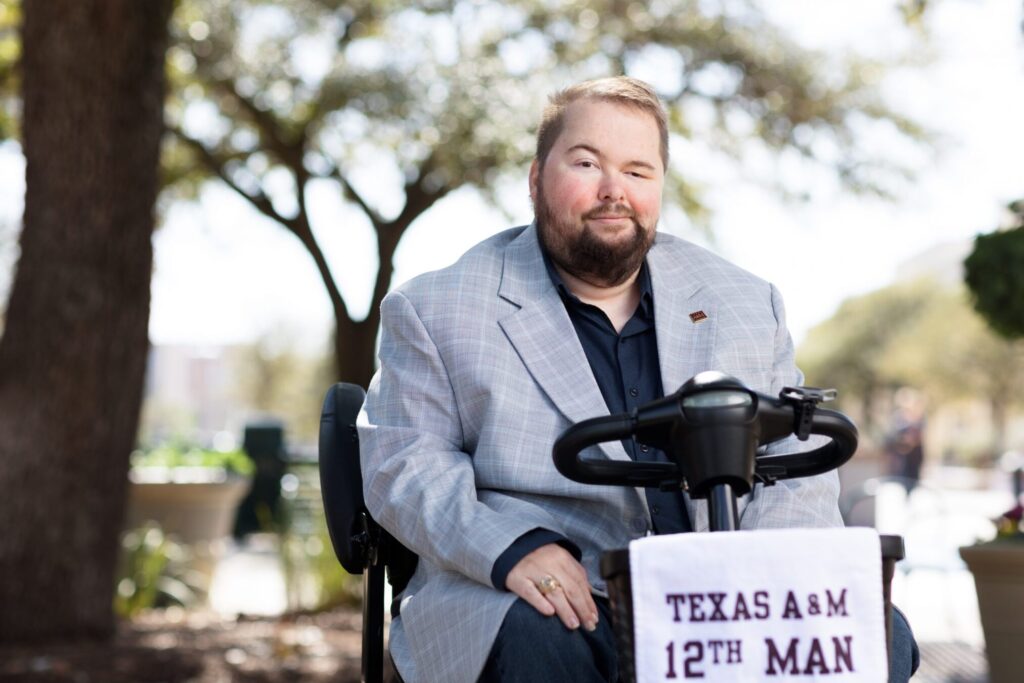
I found out I was an Aggie in first grade. A classmate asked me whether I was an Aggie or a Longhorn. I told him I didn’t know what that meant. He decided on my behalf that I was an Aggie, and I went with it.
It would take another two decades before I actually earned an Aggie Ring, and the road to get there looked nothing like I expected.
Growing up in Tomball, Texas, I was in marching band and Navy JROTC. I had plans to serve in the military after high school. During my sophomore year, complications from spinal surgery changed that. The military wasn’t going to happen the way I had imagined it. So I redirected, the way you do, and put my energy somewhere else.
In the summer of 2001, I started volunteering with the Cypress Creek Fire Department, programming their communications gear. I enrolled at Tomball Community College and started taking telecommunications classes. Then September 11th happened. I was sitting in college algebra when the news broke. My unit responded, and we were at the station in time to watch the second tower fall. I knew most of my friends from JROTC were going to war. I needed to do something that mattered.
I obtained my EMT certification and took a full-time position as a fire and EMS dispatcher for Cypress Creek Emergency Medical Services. Later I moved to the Village Fire Department, where I worked dispatch for close to a decade.
Around 2012, I enrolled in Liberty University’s online IT program. Midway through, I got hired at Apple and relocated to Austin. I worked my way up to Senior Technical Support Advisor for Mac and iOS. That job changed how I thought about learning. I was mesmerized by the way Apple trained people. I didn’t know the names of the theories yet. I just knew there were ways to help people understand technology that actually worked, and I wanted to understand why.
That question pushed me back into school. I found Texas A&M’s online Educational Technology master’s program and decided to go all in. I left Apple, moved to College Station, and got a graduate assistant position in the Division of Student Affairs IT. One of my main projects was helping build the Aggie Veteran Network for what would become the Knauss Veterans Resource and Support Center. Getting to do that work, for that population, while earning my Aggie Ring, meant a lot.
After finishing the MEd, I stayed at Texas A&M. I worked as a Digital Systems Architect at Mays Business School, then as a Technical Trainer at the Texas A&M Foundation. The whole time, I kept asking bigger questions about technology and learning, which eventually led me to Boise State University’s Educational Technology doctoral program.
I defended my dissertation in 2025. It was a bibliometric and manual literature analysis of game-based learning research, specifically examining how the field has studied engagement and learning outcomes. That project came out of years of noticing a gap between what researchers know about games and learning and what most educators actually have access to. Closing that gap is still what I care most about.
Today I work as the Digital Accessibility Manager for the University of Missouri System, making sure that the technology students and faculty rely on actually works for everyone, including people who use assistive technology to navigate it. That work connects to everything that came before it, the dispatcher who had to think clearly under pressure, the Apple advisor figuring out how to explain a concept in a way that lands, the trainer who wanted to understand the science behind what he was doing intuitively.
I’m a first-generation college student. I always had to work. I know what it costs to build something from scratch while life keeps moving. That’s also why I made a planned gift through the Texas A&M Foundation years ago, four scholarships aimed at Corps cadets, veterans, and graduate students in educational psychology. The goal is simple: make it a little easier for the next person who’s trying to figure it out.
Read the original feature story from Texas A&M’s Division of Student Affairs: Heeding the Call